Nice Shot
Continuation of why we write

Nice Shot
I like to think about the nature of writing—why anyone bothers to write, related to being where you are not, to Zen.
My Substack essays on writing are obnoxiously personal. Although I think my perspective might be generalizable, I don’t want to walk the plank there. I haven’t read Husserl, but I catch the drift of phenomenology, that organisms are locked inside themselves with a nod to brute reality. Still, I have been writing, reading, researching, and teaching writing for over fifty years, so some of what I think about writing goes beyond me.
Rather my usual political essays, I have been posting on Substack thoughts about the phenomenology of writing, mostly because of conversations I have had with friends who are writing memoirs or novels for publication.
For most of my professional life, I have been writing as an academic, which is a different kettle of fish than personal writing: getting published is part of an academic’s job. Personal writing is part of your job only if you hope to make a living as a writer. For some of us, it’s just what we do in the morning before we run off to play pickleball. If you hope to make a living by what you write, it moves into literary writing, an offshoot of personal writing.
There are a host of writing genres beyond academic and personal, such as political, journalistic, technical, or business, but for the moment, I’m sticking to academic and personal. I could draw a Venn diagram of motivations, with a shared area between these fuzzy categories (see Lakoff, Women, Fire, and Dangerous Things).
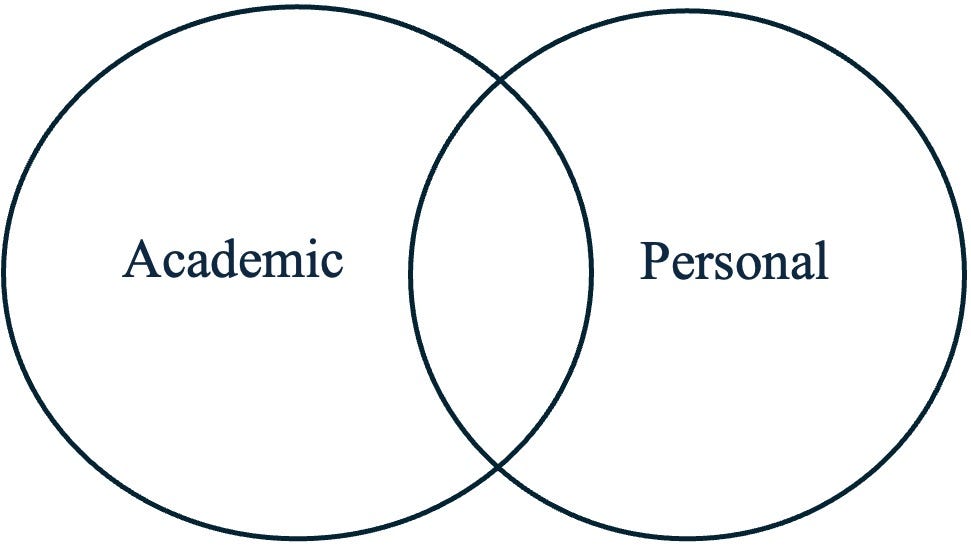
Motivations for Writing
Certainly, academics get pleasure from being published. We like being recognized. People across the nation want to be our friends; we are seldom alone in conferences. We gain tenure and promotions. You get the picture.
But the pleasure, pride, and . . . I don’t know what to call it: just the satisfaction in having made something that goes beyond one’s fleeting thought, in having materialized, fixed one’s thought—they are different in academic and personal writing.
I was part of a panel many years ago composed of Charles Cooper’s graduate students. This panel presentation at a writing teachers’ conference (CCCC) may have been after Charles died. For non-academics, Charles was one of the more important figures in the history of writing instruction. He was a wonderful person, a great friend to all of us. Many of his students went on to become leading figures in composition theory.
Once when Charles and I were flying back to San Diego from a CAP (California Assessment Program) meeting in Berkeley, we were talking about what I might focus on for a dissertation topic. I said I thought I might like to investigate how writing with computers would reshape how people write (this was about 1986 when I was a second-year graduate student in love with my Kaypro II).
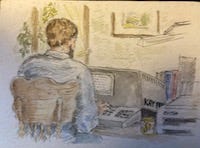
Charles was gentle with his disdain. He said, “The best computer is a number-two pencil.” I went on to write a dissertation on genre theory. Even Charles got a couple of things wrong.
After our 4C’s presentation (I think there were five of us), I remember one person in the audience addressed me and said something like, “You keep talking about getting students to enjoy writing, but aren’t you avoiding the truth that writing is hard work?”
He (he obviously was a he [see Lakoff, Moral Politics]) went on for several minutes about the hard-work ethic. Several heads in the audience nodded.
Composition theorists could be divided into the pain and pleasure groups. Pleasure people like me may have been influenced by John Dewey’s little book, Experience and Education. Dewey said that if your students don’t keep learning about your subject after the class is over, you have been misteaching.
Some academics—I think of Doug Hesse, who started the groundbreaking writing program at the University of Denver—were into the pleasure of writing. For strange reasons, ours has been a losing battle—witness the persistent influence of SAT/ACT essays, the SOLs in Virginia, and the blinding light of the five-paragraph essay, of which this reflection is NOT an example.
My wandering point is that some of the academic writing we did blurred with personal writing, particularly after we had established ourselves and knew that what we wrote would be published. One might almost call this the pleasure that simply comes from having written or having played a game you love to play. I like it when someone says, “Nice shot!” but mostly, I love making the shot. Pickleball players will understand.
At 81, I don’t have many decades left, but I hope at the end, someone will say, “Nice shot!”